


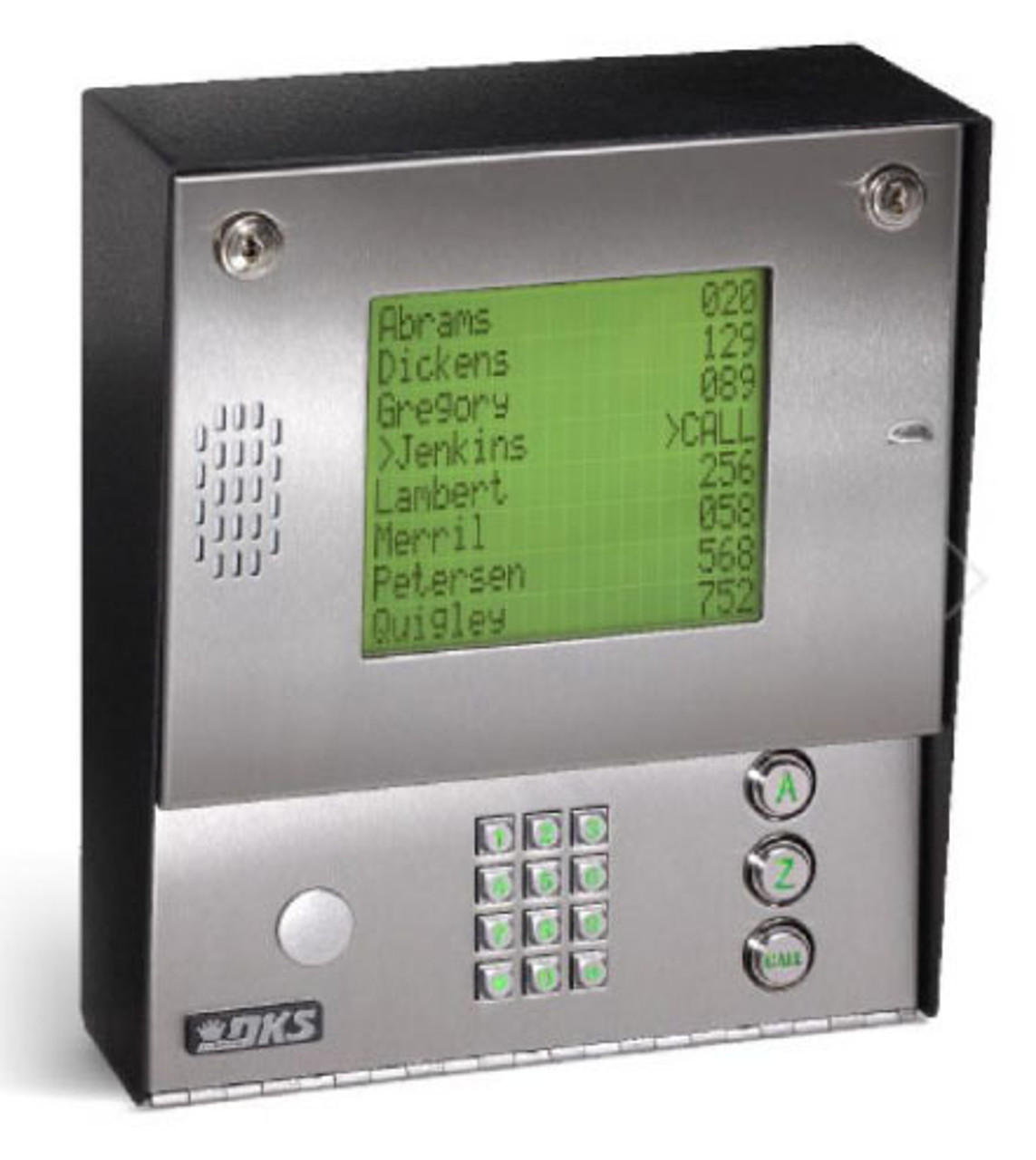
DoorKing Commercial Phone Entry & Lobby Panels
DoorKing Commercial Telephone Entry Systems & Lobby Panels
DoorKing — DKS or Door King — builds the telephone entry systems and call boxes used on apartment buildings, condominiums, gated communities, office parks and storage facilities. A visitor finds a resident in the directory, the system calls them, and they press a digit to open the gate or door.
Choosing one comes down to three things: how many residents, whether it mounts at a gate or in a lobby, and how it connects. The tables below go in that order.
Which system? Start with capacity
| Model | Capacity | Typical application |
|---|---|---|
| 1802-090 | 100 numbers | Small building or a single gated entrance |
| 1802-082 | 1,000 numbers | The workhorse. Apartment buildings and mid-size communities. |
| 1802-089 | 1,000 numbers | Same, flush mounted |
| 1808-082 | With small directory | Where a scrolling directory is wanted at the door |
| 1810-080 | 1,000 numbers with the 1810-035 chip | Established mid-range system |
| 1834-080 | 3,000 numbers | Large communities and multi-building sites |
| 1835-080 | 3,000 numbers | Higher specification than the 1834 |
| 1837-080 | Large capacity | The top of the range — largest developments |
| 1838-081 | 3,000 capacity | Access controller rather than a phone entry unit — card and code entry without the telephone directory |
| 1838-095 | 100 capacity | Access Plus controller for smaller sites |
Size for growth, not for today. Running out of directory capacity mid-tenancy means replacing the unit, not upgrading it. If you are near the limit of a 100-number system, go to 1,000. Call us with your unit count and turnover and we will size it properly.
Gate-mounted call box or lobby panel?
The same electronics come in two very different housings, and the choice depends on where people arrive.
Gate-mounted call boxes sit on a post or pillar at a vehicle entrance, reachable from a car window. Lobby panels mount in a building entrance for pedestrians, usually flush into the wall, and are built to survive a public lobby.
| Panel | Notes |
|---|---|
| 1802-084 | 1802 lobby panel |
| 1802-085 | Vandal resistant lobby plate |
| 1802-086 | Vandal resistant lobby plate |
| 1802-087 | Vandal resistant lobby plate |
| 1802-088 | Vandal resistant lobby plate |
| 1802-094 | Flush mount, hands free |
| 1803-090 | 1803 lobby panel |
| 1803-093 | 1803 lobby panel |
| 1803-094 | 1803 lobby panel |
| 1803-097 | Vandal resistant |
| 1808-081 | Surface mount, hands free |
| 1808-083 | 1808 lobby panel |
| 1810-088 | 1810 lobby panel |
| 1810-090 | 1810 lobby panel |
| 1810-094 | 1810 lobby panel |
In a public lobby, specify vandal resistant. A standard faceplate in an unsupervised entrance is a maintenance line item. The vandal-resistant plates cost a little more once and save you replacing faceplates repeatedly.
Connectivity — landline, VoIP, ethernet or cellular
Most commercial sites no longer want a dedicated copper line at the entrance. DoorKing systems run over VoIP, ethernet or cellular instead.
| Part | What it does |
|---|---|
| 2334-081 | VoIP voice and ethernet data |
| 2334-080 | VoIP / RS232 control box |
| 2334-010 | VoIP / ethernet / RS232 circuit board |
| 1815-578 | VoIP adapter kit |
| 1815-740 | Wireless modem |
| 2351-085 | Tracker board, wireless 900 MHz — links remote entry points back to the main system without trenching |
If you have network at the entrance, ethernet is the most reliable option and carries no monthly cost. Cellular suits sites with no conduit run. VoIP suits buildings already on an IP phone system.
Card readers and access control
Most commercial installations pair the phone entry with a credential reader so residents and staff badge in rather than dialling.
| Part | What it is |
|---|---|
| 1815-233 | Access Plus card reader |
| 1815-215 | DKS RF Logics proximity card reader |
| 1815-380 | HID ProxPoint Plus reader |
| 1815-390 | HID ThinLine II reader with surface mount enclosure |
| 1520-082 | Single door controller with HID reader |
| 1520-081 | Wiegand controller in housing |
| 1513-081 | Keypad for Access Plus units — not stand-alone |
| 1838-123 | Call station with HID card reader |
| 1838-122 | Call station with AWID card reader |
The reader format has to match whatever credentials the property already issues — HID, AWID or DKS Prox. Changing format means reissuing every card on site, so check before you specify.
Posts, kiosks and enclosures
The unit has to sit where a driver can reach it from the car window, set back far enough that a vehicle clears the gate. On a multi-lane entrance a kiosk gives you a single structure for the call box, reader and light.
| Part | What it is |
|---|---|
| 1200-045 | Standard post, pad mount |
| 1200-046 | Gooseneck post, in ground |
| PED42 | Gooseneck post — replaces the G559 |
| 1200-049 | Standard post |
| 1200-050 | Architectural post |
| 1200-160 | Small kiosk |
| 1200-170 | Large kiosk |
| 1200-087 | Light tower |
| 1814-200 | Flush kit — rough-in box and trim ring, 90 series |
| 1814-165 | Stainless steel flush kit |
| 1814-180 | Stainless steel hood, 90 series |
| 1200-080 | Transformer box |
| 1215-130 | Power supply, 12/24V 1 amp |
| 1215-131 | Power supply, 12/24V 2.5 amp |
Common questions
What capacity do I